
Sagging runs
A gutter that dips in the middle is almost always a hanger problem, not a gutter problem. On older homes it's spikes that have backed out of the fascia. On newer ones it's hangers spaced too far apart — three feet when it should have been two.
The repair is to pull the failed fasteners, check whether the fascia behind them is still solid, and rehang on hidden hangers at proper spacing. If the wood is soft, the hanger has nothing to bite and we're back in a year. That's why we look at fascia on every sag call.
Leaking seams and corners
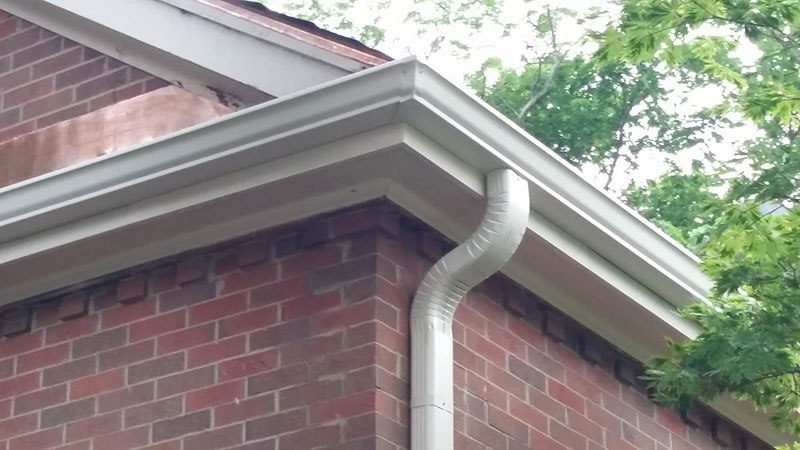
Corners leak more than anything else on a gutter. A factory-crimped miter with no sealant behind it will weep the first heavy rain, and you'll see the stain running down the wall below it before you ever see the drip.
We clean the joint back to bare metal, dry it, and reseal with a gutter-grade sealant that stays flexible through a Missouri temperature swing. Silicone caulk from a hardware store won't hold on aluminum through a winter.
Wrong pitch
If there's water sitting in your gutter two days after the rain stopped, the pitch is off. Standing water is heavy, it accelerates corrosion at the bottom seam, and it breeds mosquitoes.
Fixing pitch means rehanging the run to a proper fall. On a long ranch elevation that can mean adding a second downspout rather than trying to drag all the water 60 feet to one end.
When repair stops making sense
We'll tell you. If the bottom of the trough has gone thin, if there are already five or six patched spots, or if the profile is an obsolete 4-inch nothing connects to anymore, patching is money spent twice.
The honest math: a repair that buys two years on gutter that needs replacing in three isn't a repair, it's a delay with a bill attached.
What causes most repair calls in St. Louis
Most repairs come down to weight and movement. Wet leaves and winter ice load a gutter far past what old spikes were meant to hold, and the fastener slowly walks out of the fascia. Corner and end-cap sealant hardens through hot summers and cracks through cold winters. A clogged downspout backs water up until it finds a seam to leak from.
Storms add their own damage: limbs dropping on a run, wind getting under a loose end, a ladder leaned against the gutter during some other job. Each of these looks different from the ground, which is why we look at the whole run and not only the spot that's dripping.
How a repair visit works
We inspect the full length of the gutter and run water through it with a hose to find where the leak actually starts, since water often travels along the trough before it drips. Loose sections are re-fastened with hidden hangers into solid wood. Corners and end caps are cleaned down to bare metal and resealed. Low spots are re-pitched so water moves toward the outlet. Downspouts are cleared and tested at the bottom.
You get photos of what we found and what we fixed. If the fascia behind a run is soft, we'll show you before we fasten anything to it.
Repairs we usually finish in one visit
Re-hanging a sagging run, resealing leaking miters and end caps, re-pitching a gutter that holds water, re-attaching a downspout that's come loose, replacing a crushed elbow, adding flashing where water runs behind the gutter, and swapping a short damaged section. Bigger problems, like a run that's rusted through or fascia that's rotted along a whole side, get a written quote. For wind or hail damage, see our page on storm damage and insurance.
Signs a small gutter problem is about to get bigger
Peeling paint or dark stains on the fascia, streaks on the siding or brick under the gutter, mulch washed out of a bed, icicles hanging from the middle of a run instead of the ends, a gap opening between the gutter and the house, and standing water in the trough days after a rain. Each of these means water is going somewhere it shouldn't. Fixed early, it's usually a quick repair. Left alone, it tends to become a fascia or foundation problem.
Repairing older and mismatched gutter systems
Many St. Louis houses have gutters that were patched by several owners over the years: a newer section spliced into an old run, two different profiles meeting at a corner, or downspouts in mismatched colors. We can repair these, but we'll be honest about the limits. A splice between two different profiles is a permanent weak spot, and old thin-gauge metal doesn't hold a new fastener well. When a system has more patches than original gutter, we'll show you what a single seamless run would cost next to another round of repairs, so you can decide with real numbers. See when to replace your gutters for the warning signs.
Questions people ask
Can you repair just one section?
Yes. Plenty of jobs are a single elevation or one corner. We don't upsell a whole house when a corner is the problem.
How much does gutter repair cost?
Small repairs — a resealed miter, a few rehung feet — are usually a modest service call. Rehanging a full elevation costs more. You'll get the number before we start.
My gutter is pulling away from the house. Is that urgent?
Fairly. Once the back of the gutter separates from the fascia, water runs behind it and into the board. Left alone through a season, a hanger problem becomes a carpentry problem.
Do you repair gutters you didn't install?
Yes, most of what we repair was installed by somebody else.
Will you tell me if it needs replacing instead?
We will, with the reason. Family business, third generation. Selling somebody a patch we know won't hold is not how that lasts.
Why does water drip behind my gutter instead of through it?
Usually because there's no flashing bridging the roof edge and the back of the gutter, so water runs down the fascia instead of into the trough. We add flashing that carries it into the gutter.
Can a dented gutter be repaired?
Minor dents that don't change how water flows can stay. A crushed or kinked run gets replaced. On seamless gutter that usually means the whole run, since the run is one piece.
How long does a gutter repair last?
It depends mostly on the wood. A gutter re-fastened into sound fascia holds for years. A gutter fastened into rotted board won't hold, which is why we fix the wood first.
Free estimate
We measure, we look at the fascia, and you get a number in writing.
Talk to a real St. Louis gutter company
Third generation, family-run since 1947. Somebody picks up, day or night.